
Room Addition Costs in Chicago 2026: Neighborhood-by-Neighborhood Pricing Guide

Get realistic room addition costs for your specific Chicago neighborhood. We break down pricing by area, from Lincoln Square to Skokie, so you can plan your budget accurately.
Room addition pricing in Chicago varies significantly by neighborhood and suburb because labor costs, material pricing, and construction complexity differ across the city. A room addition in Lincoln Park costs substantially more than the same addition in Portage Park, partly because labor rates are higher in desirable neighborhoods and partly because older properties in historic neighborhoods face unique structural challenges and permitting complications. National room addition cost calculators provide generic per-square-foot pricing that doesn't reflect Chicago's specific market conditions. Homeowners planning additions need realistic pricing for their actual neighborhood so they can budget accurately and understand whether they're getting competitive quotes from contractors. This guide breaks down 2026 room addition costs by Chicago neighborhood and surrounding suburbs, helping you understand what quality room additions actually cost in the market where you're building.
Understanding Room Addition Cost Variables
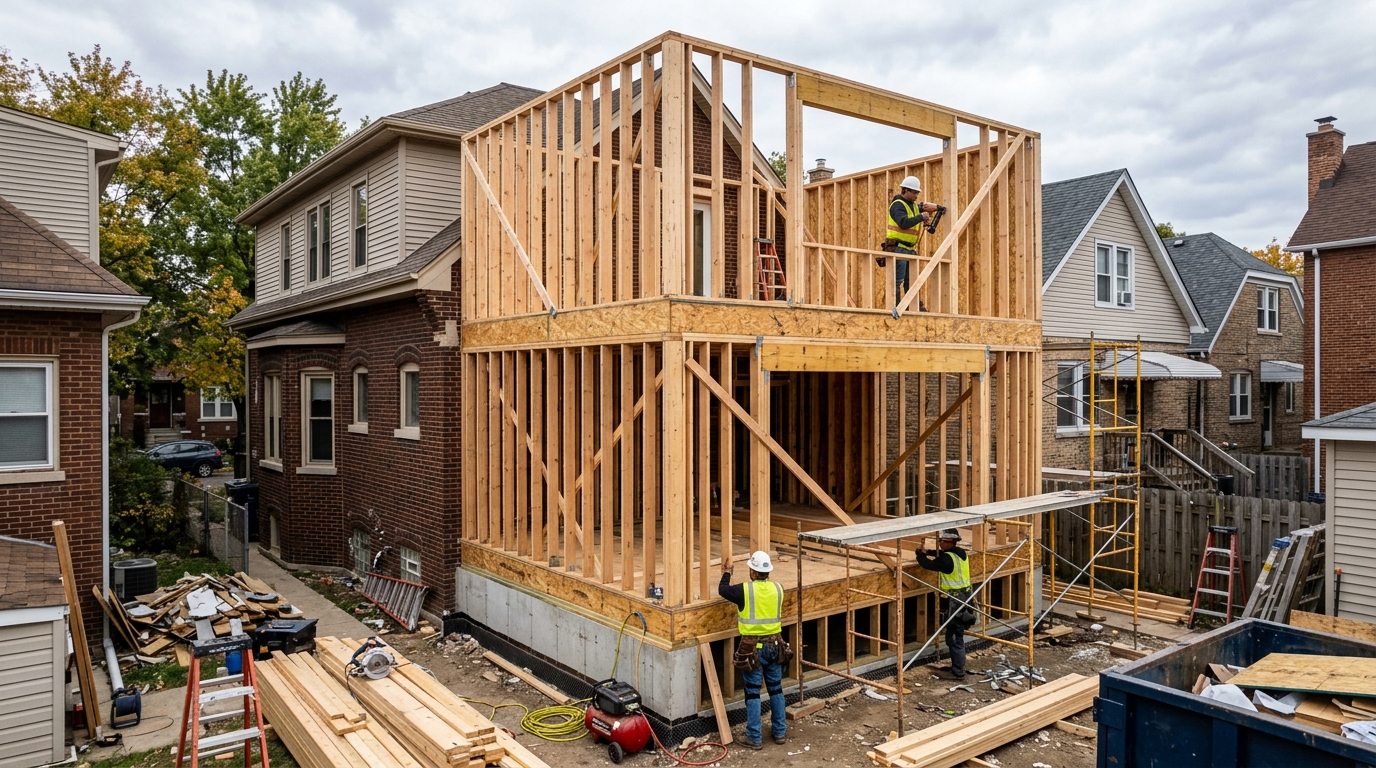
Room addition costs depend on multiple factors beyond square footage. A first-floor addition built on an existing foundation is less expensive than a second-story addition that requires foundation reinforcement and structural engineering. An addition in a home with modern systems is less expensive than additions in older homes where existing plumbing, electrical, and HVAC systems might need upgrades to serve the new space. Finishes matter significantly—basic drywall and standard fixtures cost less than high-end materials and custom finishes. Permit complexity in historic districts drives costs higher than in non-historic areas. Labor rates vary by neighborhood and contractor expertise. These variables mean your actual cost might be higher or lower than these estimates depending on your specific situation, but these ranges reflect current 2026 Chicago market conditions for quality work.
Cost Per Square Foot: Chicago Baseline
Room addition costs in Chicago typically range from $200 to $400 per square foot for a basic first-floor addition and $300 to $500 per square foot for a second-story addition, accounting for material and labor combined. These figures assume standard construction with moderate finishes, not budget basement construction or luxury high-end finishes. A 200-square-foot first-floor addition ranges from $40,000 to $80,000 depending on scope and finishes. A 300-square-foot second-story addition ranges from $90,000 to $150,000. These are not including permits, design, or contingencies—they're purely construction cost. When you add design fees ($1,500-4,000), permits ($500-2,000), and contingency (typically 10-15% of construction cost), your total project cost increases 15-20%.
The variation within these ranges is significant. At the lower end ($200-250 per square foot), you're getting clean, straightforward construction with basic finishes. At the higher end ($350-400 per square foot), you're getting better materials, custom finishes, and higher-quality workmanship. Prices above $400 per square foot suggest high-end materials, custom design, or complex structural work. Below $200 per square foot raises questions about whether corners are being cut.
Chicago Neighborhood Breakdown
Room addition costs vary meaningfully by neighborhood because of labor rates, material costs, and local construction factors. Understanding your neighborhood's baseline helps you evaluate whether contractor quotes are competitive.
Lincoln Park and Lakeview: These desirable lakefront neighborhoods command premium pricing. First-floor additions cost $280-380 per square foot. Second-story additions cost $380-500 per square foot. For a 200-square-foot first-floor addition, budget $56,000-76,000. For a 300-square-foot second-story addition, budget $114,000-150,000. Higher costs reflect strong demand for contractors, higher labor rates, and the complexity of working in older Victorian and greystone properties common in these neighborhoods. Historic district designation in parts of Lakeview adds permitting complexity that increases timelines and costs.
Rogers Park and Avondale: These neighborhoods offer slightly more moderate pricing than Lakeview while still maintaining strong real estate values. First-floor additions cost $240-340 per square foot. Second-story additions cost $340-450 per square foot. For a 200-square-foot first-floor addition, budget $48,000-68,000. For a 300-square-foot second-story addition, budget $102,000-135,000. These neighborhoods have older housing stock similar to Lakeview but slightly less competitive contractor markets, resulting in slightly lower pricing. Labor rates are still higher than outer neighborhoods.
Lincoln Square and Ravenswood: These neighborhoods are popular with families and young professionals, balancing neighborhood desirability with slightly more moderate pricing than lakefront areas. First-floor additions cost $220-320 per square foot. Second-story additions cost $320-420 per square foot. For a 200-square-foot first-floor addition, budget $44,000-64,000. For a 300-square-foot second-story addition, budget $96,000-126,000. These neighborhoods have solid real estate demand without the premium pricing of lakefront areas. Many homes are historic bungalows and greystones with structural character but also complexity.
Portage Park and Jefferson Park: These northwest side neighborhoods offer more moderate pricing for families building for long-term ownership rather than investment flip potential. First-floor additions cost $200-280 per square foot. Second-story additions cost $280-380 per square foot. For a 200-square-foot first-floor addition, budget $40,000-56,000. For a 300-square-foot second-story addition, budget $84,000-114,000. These neighborhoods have less real estate pressure than central Chicago but still have solid contractor availability. Labor rates are noticeably lower than lakefront neighborhoods.
Pilsen and Bridgeport: These neighborhoods on Chicago's south side offer the most moderate pricing in Chicago's established neighborhoods. First-floor additions cost $180-260 per square foot. Second-story additions cost $260-360 per square foot. For a 200-square-foot first-floor addition, budget $36,000-52,000. For a 300-square-foot second-story addition, budget $78,000-108,000. Gentrification is increasing prices in parts of Pilsen, but overall pricing remains more moderate. Contractor availability is good and competition keeps prices competitive.
Suburban Pricing
Room addition costs in Chicago suburbs vary based on the suburb's proximity to the city, desirability, and contractor market dynamics.
Evanston: As a highly desirable suburb immediately north of Chicago with strong real estate values, Evanston pricing is comparable to or slightly higher than Chicago lakefront neighborhoods. First-floor additions cost $260-360 per square foot. Second-story additions cost $360-480 per square foot. For a 200-square-foot first-floor addition, budget $52,000-72,000. For a 300-square-foot second-story addition, budget $108,000-144,000. Much of Evanston is in historic districts with strict design review requirements that add permitting time and cost. Labor rates are high, reflecting strong demand and proximity to Chicago's competitive market.
Oak Park: Another highly desirable suburb west of Chicago with strong real estate values and significant historic designation. Pricing is comparable to Evanston. First-floor additions cost $250-350 per square foot. Second-story additions cost $350-460 per square foot. For a 200-square-foot first-floor addition, budget $50,000-70,000. For a 300-square-foot second-story addition, budget $105,000-138,000. Oak Park's strict historic preservation requirements and Frank Lloyd Wright architectural legacy create premium pricing. Contractors experienced in historic compliance charge appropriately for that expertise.
Skokie and Morton Grove: These suburbs northwest of Chicago are more moderately priced than Evanston and Oak Park while still maintaining solid real estate values. First-floor additions cost $200-290 per square foot. Second-story additions cost $290-390 per square foot. For a 200-square-foot first-floor addition, budget $40,000-58,000. For a 300-square-foot second-story addition, budget $87,000-117,000. These suburbs have less historic district pressure than Evanston and Oak Park, simplifying permitting and reducing costs slightly. Contractor availability is good, keeping pricing competitive.
Northbrook and Wilmette: These affluent north shore suburbs command pricing comparable to premium Chicago neighborhoods. First-floor additions cost $270-370 per square foot. Second-story additions cost $370-490 per square foot. For a 200-square-foot first-floor addition, budget $54,000-74,000. For a 300-square-foot second-story addition, budget $111,000-147,000. These suburbs have strong real estate values and desirable school districts, creating demand for quality work. Labor costs are high, reflecting the affluent character of these communities.
First-Floor vs. Second-Story Addition Costs
Second-story additions cost roughly 30-50% more than first-floor additions because of the structural engineering required. A second-story addition requires that existing foundations and structural systems be engineered to support the additional weight. Reinforcement might be necessary, adding cost. Second-story construction requires more complex framing, roof integration, and potential HVAC and plumbing modifications. These factors drive second-story costs significantly higher than first-floor additions of the same square footage.
For cost comparison in 2026 Chicago: A 200-square-foot first-floor addition averages $45,000-70,000 depending on neighborhood. The same 200-square-foot second-story addition averages $65,000-100,000+ depending on neighborhood and structural requirements. The premium reflects legitimate additional complexity and structural engineering, not gouging. Budget for this significant cost difference when deciding between first-floor and second-story options.
Material and Labor Breakdown
Room addition costs break down roughly into 40-50% materials and 50-60% labor, with some variation based on complexity. For a $60,000 room addition, expect $24,000-30,000 in materials and $30,000-36,000 in labor. For a $100,000 second-story addition, expect $40,000-50,000 in materials and $50,000-60,000 in labor. Labor costs vary significantly by neighborhood—rates in premium neighborhoods can be 20-30% higher than in moderate-cost neighborhoods. Material costs are more standardized but still vary based on quality choices and supplier competition in specific areas.
Budget and Contingency Planning
When planning your room addition budget, add 10-15% contingency to your estimated cost. Structural issues discovered during construction, soil conditions that affect foundations, or code compliance modifications discovered during permitting all add cost. A $60,000 addition with 15% contingency budgets for $69,000 total. This contingency isn't pessimistic—it's realistic. Projects that discover no issues are pleasant surprises; projects that exceed budget because of unexpected conditions are common. Budget conservatively rather than optimistically.
Also budget for design and engineering costs. A qualified architect or designer charges $1,500-4,000 depending on complexity. Structural engineers might charge additional fees if required. Permits cost $500-2,000 depending on municipality and complexity. These costs are separate from construction and often overlooked when homeowners estimate room addition costs. A complete budget includes all of these elements, not just construction cost.
Comparing Contractor Quotes
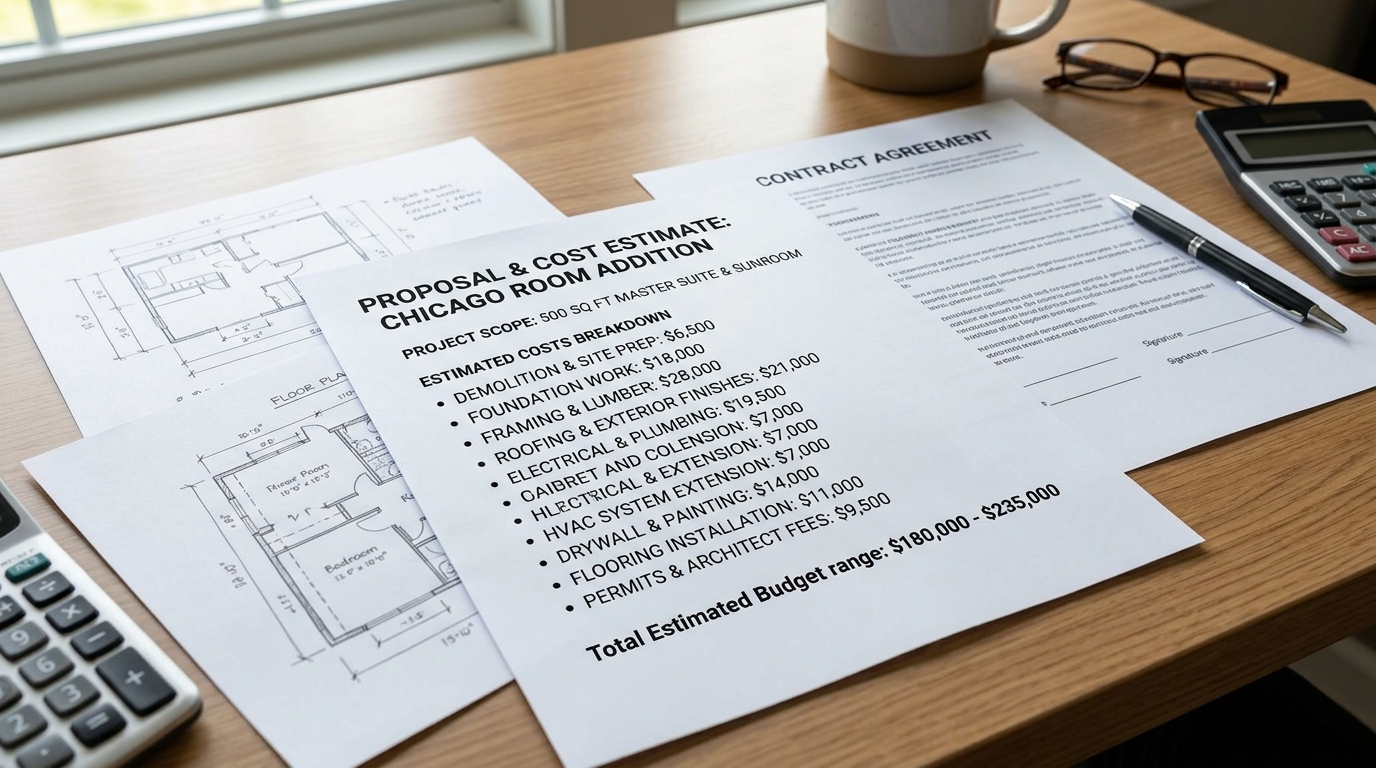
When you're evaluating contractor quotes for your room addition, ensure you're comparing equivalent scope. A quote of $45,000 and a quote of $65,000 for the same 200-square-foot addition suggests either different quality levels, different finishes, or one contractor is making a mistake. Ask contractors to itemize their quotes showing materials, labor, overhead, and profit. Understand what's included in each quote and what's not. Is permit cost included? Design cost? Contingency? Does the quote include interior finishing or just shell? These details explain pricing differences.
Get quotes from at least three contractors. Wide variation warrants investigation—ask the low bidder why their price is lower and ask the high bidder what justifies their premium. Often the middle quote represents realistic market pricing, but not always. Geographic variation and contractor specialization affect pricing legitimately. A contractor specializing in high-end custom additions might quote higher but deliver superior finishes. A contractor with strong connections to material suppliers might quote lower without compromising quality. Evaluate the entire package—price, contractor experience, timeline, warranty—not just cost.
Getting Accurate Estimates for Your Specific Project
These neighborhood pricing guides represent current market conditions, but your actual cost depends on your specific property and project scope. An addition with complex structural requirements, custom finishes, or in a historic district with design review requirements will cost more than baseline estimates. An addition with minimal structural complexity and standard finishes might cost less. Get contractor estimates for your specific situation rather than relying purely on neighborhood averages. A quality contractor will assess your property, discuss your addition goals, and provide detailed estimates reflecting your actual project rather than generic calculations.
Budget Construction has completed room additions throughout Chicago and surrounding suburbs and understands neighborhood-specific pricing and local market conditions. We can assess your property, discuss your addition goals, and provide realistic estimates for your specific project location and scope. If you're planning a room addition in Chicago or suburbs and want guidance on realistic costs for your neighborhood, visit https://budgetconstructioncompany.com/ to schedule a consultation. We'll walk you through the variables affecting your project cost and provide detailed estimates so you can plan your budget accurately.